The Best Medical Alert Smartwatches of 2026
The Golden Standard is reader-supported. When you buy through links on our site, we may earn a commission. Our rankings are never for sale.
Last updated: October 2026. Prices change often — always confirm current pricing on each company’s own website before you buy.
A quick note on our approach: We don’t take money from medical alert companies for placement in our rankings, and we never will. Our picks are based on published pricing and terms, independent testing, and what actually matters in an emergency.
Please note: A medical alert smartwatch is an emergency response device, not medical care. This article is for information only.
The short version
If the idea of a pendant or a base station doesn’t appeal, a smartwatch puts the help button on your wrist. Three options are worth your attention: the Bay Alarm SOS Smartwatch (simplest, $39.95/month), the Medical Guardian MGMove (most capable, ~$49.95/month), and the Apple Watch SE (no monthly fee, but no monitoring center either).
One honest truth up front: every watch here needs charging every night. There is no medical alert smartwatch that runs for days. If nightly charging sounds like a dealbreaker, a traditional pendant with a multi-year battery (see our best medical alert systems) may serve you better.
At a glance
| Bay Alarm SOS Smartwatch | Medical Guardian MGMove | Apple Watch SE (cellular) | |
|---|---|---|---|
| Our take | Simplest | Most features | No monthly fee |
| Device cost | ~$199 | $199.95 | From $249 |
| Monthly monitoring | $39.95 | ~$49.95 | $0 |
| Fall detection | +$10/mo | +$10/mo | Free (built in) |
| Monitoring center | Yes, 24/7 U.S. | Yes, 24/7 U.S. | No — calls 911 directly |
| Smartphone needed | No | No (for safety features) | Yes — iPhone required |
| Battery | Charge daily | Charge daily | Charge daily |
| Water resistance | IP67 (shower-safe) | IP67 (shower-safe) | Swim-proof |
Simplest: Bay Alarm SOS Smartwatch
Device ~$199; monitoring from $39.95/month
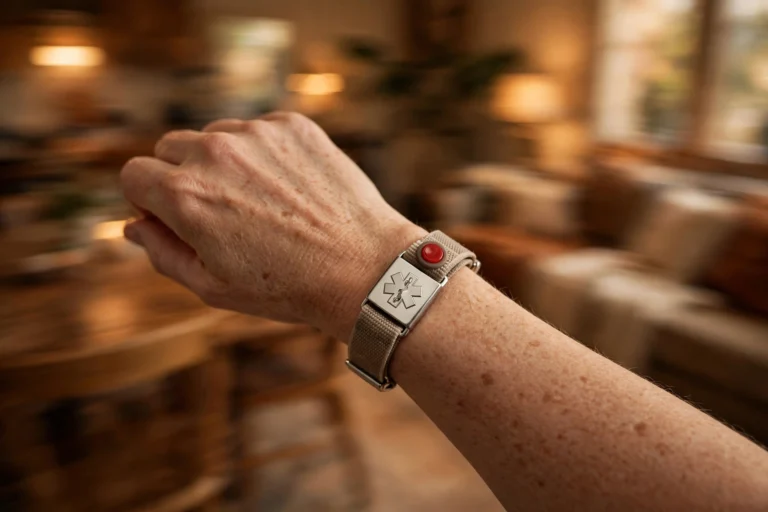
The SOS Smartwatch is the least intimidating option: one large SOS button (hold for two seconds), a simplified interface, GPS tracking, two-way voice, and no smartphone required — it runs on its own cellular connection. Independent testers connected to Bay Alarm’s monitoring center in about 10–16 seconds.
Good for: Someone who wants protection on the wrist with the absolute minimum to learn.
The trade-offs: It’s deliberately basic — don’t expect apps, messaging, or fitness tracking. Fall detection adds $10/month. And like every watch here, it needs nightly charging.
Most features: Medical Guardian MGMove
Device $199.95; monitoring from ~$49.95/month
The MGMove is the closest thing to a full smartwatch in the medical alert world: touchscreen, GPS, two-way voice, step counting, weather, and text-to-speech messaging, on top of 24/7 monitoring with Medical Guardian’s famously fast response times (around 10 seconds in independent tests). Reviewers give it top marks for design and GPS accuracy.
Good for: An active person who’s comfortable with a touchscreen and wants the most capable device.
The trade-offs: It’s the priciest option here, more features means slightly more to learn, and fall detection is another $10/month. (Note: some older sources list lower monthly prices — confirm the current rate on Medical Guardian’s site, as it appears to have risen.)
No monthly fee: Apple Watch SE (cellular)
Device from $249; monitoring $0/month
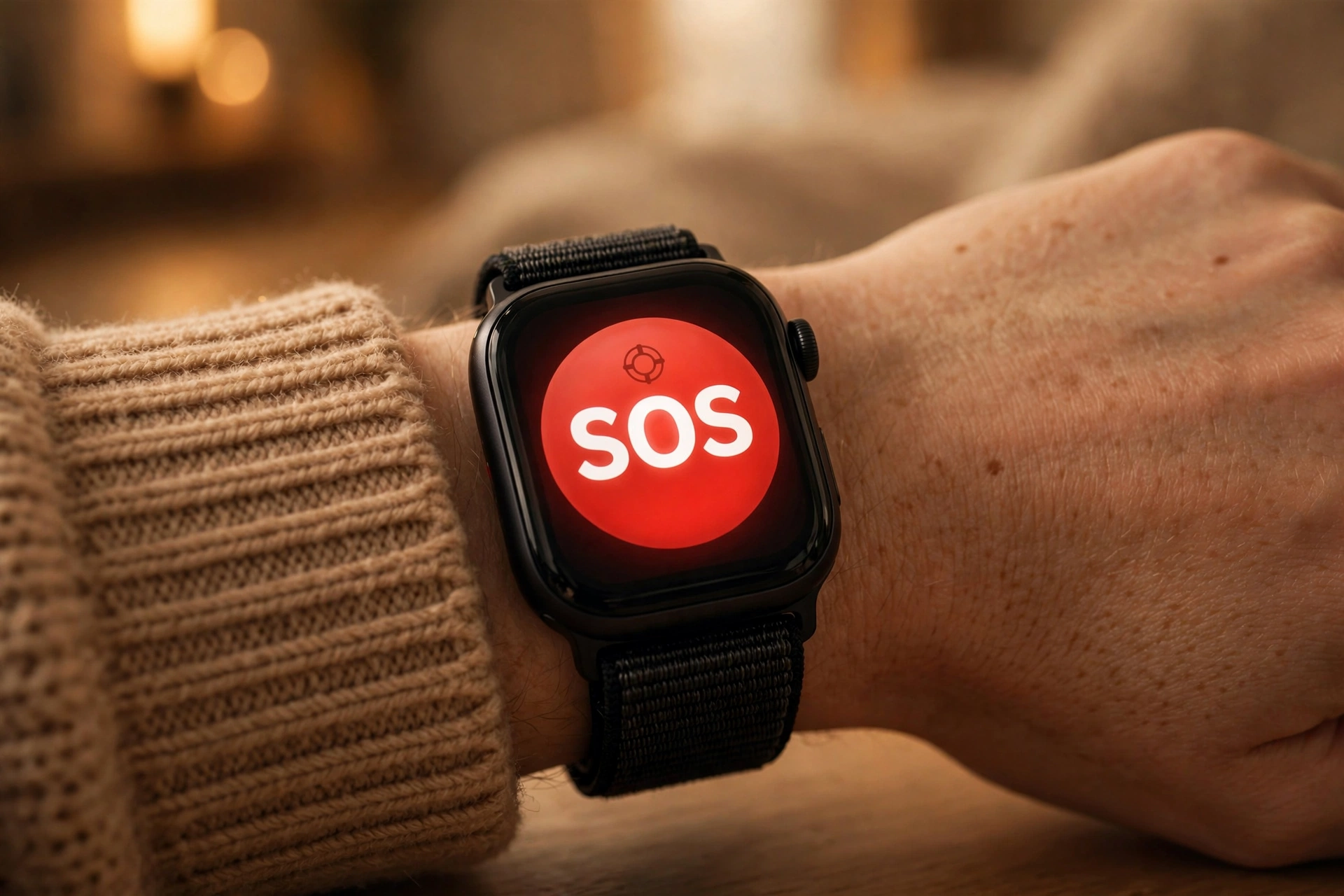
The mainstream alternative. The Apple Watch has excellent automatic fall detection (enabled by default for users 55 and older): on a hard fall it taps your wrist and sounds an alarm, and if you don’t move for about a minute, it calls emergency services directly and texts your emergency contacts with your location. No monthly fee, ever.
But understand the fundamental difference: there is no monitoring center. A dedicated medical alert connects you to a trained operator who stays on the line, follows your care plan, and calls family if 911 isn’t needed. The Apple Watch calls 911 — full stop. For many situations that’s exactly right; for others (a fall where you’re shaken but okay), a human intermediary is kinder than a dispatch.
Good for: iPhone users who want fall detection without another monthly bill, and who are comfortable with a touchscreen.
The trade-offs: Requires an iPhone (non-negotiable). The interface is the most complex here. And you’ll want the cellular model (plus a carrier plan, roughly $10–20/month) for it to work independently of your phone.
What about Lively and MobileHelp watches?
You may see older articles mention them. As of 2026, neither Lively nor MobileHelp sells a smartwatch-style medical alert device — MobileHelp discontinued theirs, and Lively’s lineup is pendants and phones. If a review recommends one, check its publish date.
How to choose
- How do you feel about gadgets? If “as simple as possible” is the priority, the Bay Alarm watch wins. If you already use a smartphone comfortably, the MGMove or Apple Watch are fine.
- Do you have an iPhone? If yes, the Apple Watch deserves a serious look — zero monthly fees is a powerful argument. If no, forget it; it’s not an option.
- Do you want a human in the loop? A monitoring center operator who knows your care plan is the core value of the dedicated watches. If that matters, skip the Apple Watch.
- Can you commit to nightly charging? Be honest with yourself. Every option here dies within about a day. A dead watch protects no one.
The bottom line
- Want the simplest wrist protection: Bay Alarm SOS Smartwatch — one button, no smartphone needed.
- Want the most capable device: Medical Guardian MGMove — the closest to a real smartwatch with a monitoring center behind it.
- Want no monthly bill: Apple Watch SE (cellular) — excellent fall detection that calls 911, if you’re an iPhone user.
And the unglamorous truth one more time: whichever you choose, it only works if it’s charged and on your wrist. Make it part of the morning routine, like glasses.